Trainings and professional development

Learn with state support

Two state-endorsed programmes with hands-on exercises, video recording and individual feedback.

Filter:

Showing 33 courses

State-endorsed programmes

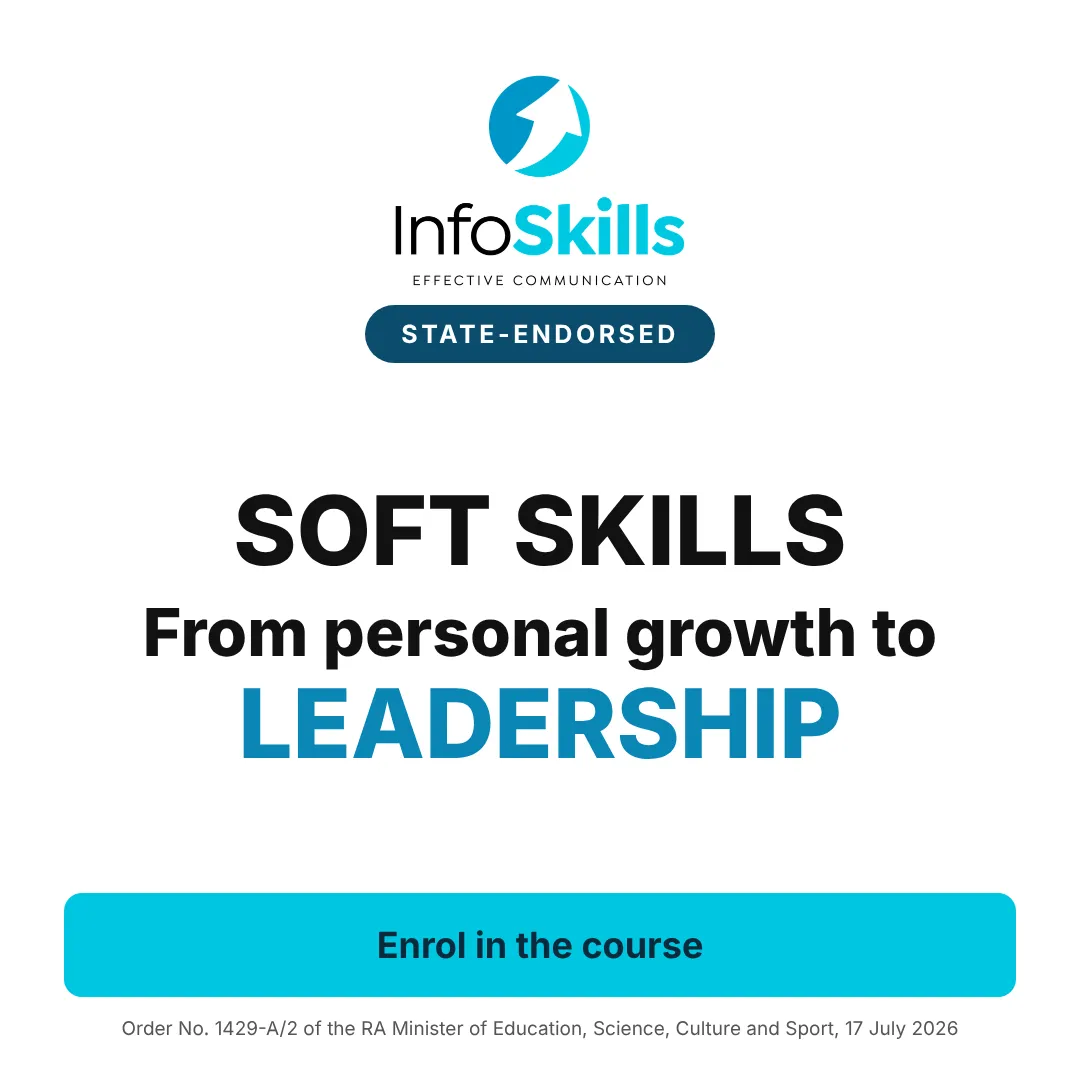
Soft Skills: From Personal Growth to Leadership

A state-endorsed programme. Learn with state support and reclaim up to AMD 100,000 of your tuition fees.

The programme was approved by Order No. 1429-A/2 of the Minister of Education, Science, Culture and Sport of the Republic of Armenia, dated 17 July 2026, as a modular supplementary education programme, and is delivered under the state reimbursement scheme. What state endorsement means for you - High quality: the programme meets state educational standards. - Financial benefit: the right to an income tax refund on your tuition fees. - Up to AMD 100,000: reimbursement of tuition fees paid, in accordance with the procedure established by law. The right to an income tax refund is granted under the social credit scheme, in accordance with the procedure established by the tax legislation of the Republic of Armenia.
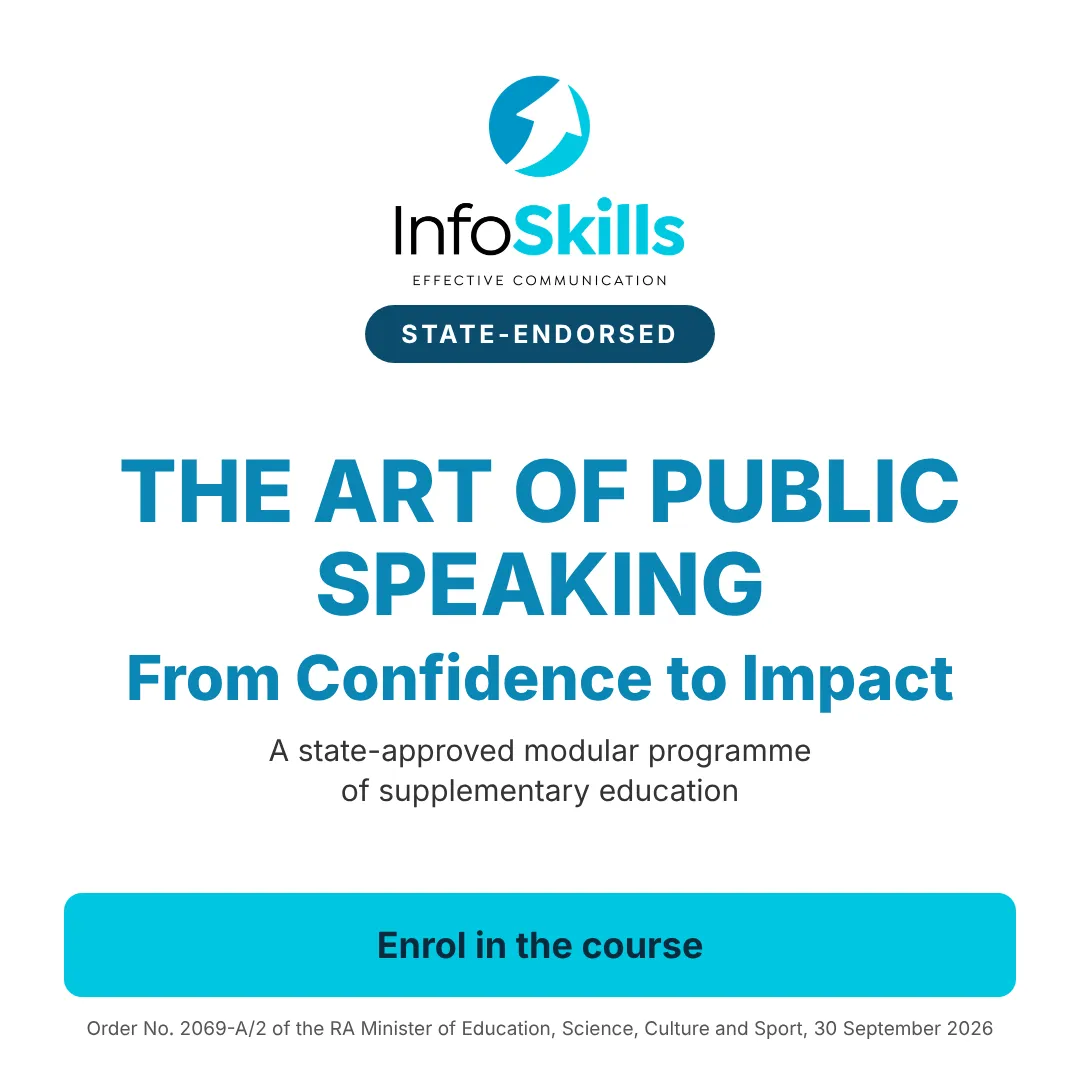
The Art of Public Speaking: From Confidence to Impact

A state-approved modular supplementary education programme. Learn with state support and reclaim up to AMD 100,000 of your tuition fees.

A state-approved modular supplementary education programme. The programme was approved by Order No. 2069-A/2 of the Minister of Education, Science, Culture and Sport of the Republic of Armenia, dated 30 September 2026, and is delivered under the state reimbursement scheme. What state endorsement means for you - High quality: the programme meets state educational standards. - Financial benefit: the right to an income tax refund on your tuition fees. - Up to AMD 100,000: reimbursement of tuition fees paid, in accordance with the procedure established by law. The right to an income tax refund is granted under the social credit scheme, in accordance with the procedure established by the tax legislation of the Republic of Armenia.
Skills and competency development

Self-Awareness

Recognising your own strengths and weaknesses, values and emotions.

Self-awareness is the ability to recognise, understand and consciously evaluate your own feelings, mindset, values, strengths and weaknesses. It enables you to notice your emotional state in different situations, understand the causes of your reactions, be aware of how your behaviour affects others, and make decisions based on your own values rather than circumstances. During the course, participants will learn to assess their abilities and limitations honestly, recognise hidden patterns of behaviour and apply these skills in communication, at work and in their personal growth.

3 days, 24 hours · In person / online / hybrid

Emotional Self-Regulation

The ability to manage emotions and choose a conscious response.

Emotional self-regulation is the ability to recognise, understand and consciously manage your own emotions, as well as to take other people's emotions into account. It allows you to pause at the moment an emotion flares up, replace an automatic reaction with a conscious choice, stay calm in tense situations, prevent conflict and create an environment of trust. During the course, participants will learn to understand the origins of emotions, manage stress and express emotional tension constructively, and to apply these skills in teamwork, leadership and dealing with clients.

3 days, 24 hours · In person / online / hybrid

Resilience

The ability to bounce back quickly from stress and failure.

Resilience is the ability to overcome difficulties, adapt to change and recover quickly from stressful situations and setbacks. It allows you to see failure as experience and an opportunity for growth, stay focused and balanced under pressure, keep going even in complex situations and support your team in difficult moments. During the course, participants will learn to develop psychological flexibility and emotional stability, draw lessons from setbacks, and apply these skills in fast-changing, high-responsibility situations at work and in everyday life.

3 days, 24 hours · In person / online / hybrid

Self-Motivation

Inner drive and consistency without external supervision.

Self-motivation is the ability to set goals independently, take the initiative and act consistently, regardless of external incentives or difficulties. It means you do not have to wait for external supervision or constant encouragement, and it lets you stay productive and overcome obstacles even on low-mood days. During the course, participants will learn to find their inner “why”, build clear goals around it, form habits that work, manage their own energy, assess their own progress, and apply the skills they have gained in both work and everyday situations.

3 days, 24 hours · In person / online / hybrid

Accountability

Taking responsibility and keeping your commitments.

Accountability is the willingness to take responsibility for your own decisions, actions and results. It enables you to be clearly aware of your commitments, keep the promises you make, admit mistakes and correct them, and build trusting working relationships. During the course, participants will learn to define commitments, report back on time, replace a “someone else is to blame” mindset with an “I can make a difference” attitude, evaluate their own work, and apply the skills they have gained in their team, at work and in their relationships.

3 days, 24 hours · In person / online / hybrid

Time Management

Clarifying priorities and staying focused.

Time management is the ability to plan work effectively, set the right priorities and use time purposefully in order to achieve set results. It allows you to tell the important from the urgent, allocate resources effectively, meet deadlines, protect your focus from distractions and work not harder but smarter. During the course, participants will learn to categorise tasks, plan their day around their own energy rhythms, assess their workload and say “no” to what is unnecessary, and to apply these skills in multitasking environments, under tight deadlines and in conditions of high responsibility.

3 days, 24 hours · In person / online / hybrid

Lifelong Learning Mindset

A systematic and conscious approach to self-development.

A lifelong learning mindset is the willingness and ability to keep developing your own knowledge, skills and thinking in order to stay relevant in a changing environment. It allows you to turn self-development into a system, with clear goals and habits, to see mistakes as lessons, to turn curiosity into action and to apply what you learn straight away in life and at work. During the course, participants will learn to set self-development goals, seek out new information, accept feedback, analyse their own experience, try out new approaches and step out of their comfort zone, so as to maintain their competitiveness and professional growth.

3 days, 24 hours · In person / online / hybrid

Critical Thinking

Analysing information and questioning assumptions.

Critical thinking is the ability to analyse information in depth, evaluate arguments and draw well-founded conclusions. It enables you to distinguish fact from opinion, uncover hidden assumptions and faulty reasoning, and make decisions based on evidence rather than emotions or stereotypes. During the course, participants will learn to analyse the reliability of sources, build logical arguments and apply these skills to solving problems in their studies, at work and in everyday life.

3 days, 24 hours · In person / online / hybrid

Structured Problem-Solving

Breaking a problem down into stages and analysing cause and effect.

Structured problem solving is the ability to analyse complex problems with clear steps and a systematic approach, and to find effective solutions. It helps you define the problem correctly, identify its root causes, propose several alternative solutions, evaluate them against criteria and choose the best one, avoiding random or hasty decisions. During the course, participants will become familiar with the key problem-solving methods and tools (for example, the “5 Whys”, the cause-and-effect diagram and the decision matrix), will learn to apply them in practical situations, and will develop the skills to think systematically and act with a focus on results.

3 days, 24 hours · In person / online / hybrid

Decision-Making

Assessing risks, impacts and options.

Decision-making is the process of choosing the best-founded of several possible options and taking responsibility for that choice. It involves clarifying the goal, gathering the necessary information, comparing options in terms of risks and benefits, and implementing the chosen solution, even under uncertainty. During the course, participants will learn about the main decision-making models and tools (for example, “benefits and risks” analysis, the criteria matrix and SWOT), explore the cognitive biases that distort our choices, and learn to make balanced, well-founded decisions in good time, in both work and everyday situations.

3 days, 24 hours · In person / online / hybrid

Systems Thinking

A holistic view of interconnected influences and processes.

Systems thinking is the ability to view phenomena and problems as a whole made up of interconnected elements, and to understand the links between them, their feedback loops and their long-term consequences. It helps you see recurring patterns rather than isolated incidents, identify the root causes of a problem and anticipate how a single change will affect the whole system, avoiding short-term, superficial fixes. During the course, participants will learn the key concepts and tools of systems thinking (for example, causal loops, the “iceberg” model and leverage points), learn to map complex situations, and develop the skills to take a holistic, far-sighted approach to problems at work and in everyday life.

3 days, 24 hours · In person / online / hybrid

Creative Thinking

Generating new ideas and exploring alternatives.

Creative thinking is the ability to put forward new ideas, look at problems from an unusual angle and find solutions that are original and, at the same time, practical. It helps you step outside habitual ways of thinking, see connections between seemingly unrelated phenomena and turn ideas into workable results, without fear of experimenting or making mistakes. During the course, participants will become familiar with the key methods and tools of creative thinking (for example, brainstorming, SCAMPER, mind maps and design thinking), learn to overcome mental blocks, and develop the skills to generate ideas, evaluate them and bring them to life, in both work and everyday situations.

3 days, 24 hours · In person / online / hybrid

Innovation Orientation

The ability to turn ideas into action and value.

Innovative thinking is an orientation towards spotting new opportunities, being open to change and turning ideas into results of practical value: new services, methods or solutions. Unlike creative thinking, which focuses on generating ideas, innovation is directed at implementing and testing them and creating real value. It helps you not to settle for the status quo, to respond in good time to changing conditions and to drive improvements forward with purpose. During the course, participants will learn about the main stages and tools of the innovation process (for example, design thinking, prototyping, MVP and rapid experiments), learn to assess the feasibility and risks of ideas, overcome resistance to change, and develop the skills of initiative and introducing new solutions, in both work and everyday situations.

3 days, 24 hours · In person / online / hybrid

Strategic Thinking

Shaping a long-term vision and anticipating impact.

Strategic thinking is the ability to see long-term goals clearly, analyse changes and trends in the external and internal environment, and on that basis decide on priorities and directions for action. It helps you rise above day-to-day problems, anticipate possible scenarios, see opportunities and threats, and focus resources on the most important goals instead of spreading them too thinly. During the course, participants will become familiar with the key tools of strategic analysis (for example, SWOT, PESTEL, scenario planning and goal cascading), learn to define a vision and measurable goals and build an action plan, and develop the skills to think in a far-sighted, goal-oriented way, for both work and personal decisions.

3 days, 24 hours · In person / online / hybrid

Effective Communication

The ability to express your ideas clearly and persuasively.

Effective communication is the ability to convey thoughts, information and feelings in a way that is clear, concise and understandable to the other person, as well as to listen to them attentively and understand them correctly. It helps you build trusting relationships, avoid misunderstandings and conflicts, present your point of view persuasively and collaborate within a team to achieve a shared result. During the course, participants will learn the core principles and tools of communication (for example, active listening, questioning techniques, giving feedback and non-verbal communication), learn to adapt what they say to their audience and the situation, and develop the skills to express themselves clearly, hold constructive conversations and manage difficult ones, in both work and everyday situations.

3 days, 24 hours · In person / online / hybrid

Active Listening

Listening to understand, not to reply.

Active listening is the ability to listen to the other person with full attention, to understand correctly both the content and the emotional subtext of what they say, and to show them that you have done so. It helps you avoid misunderstandings, gain a deeper understanding of the other person's needs and point of view, create an atmosphere of trust and build effective relationships founded on mutual regard. During the course, participants will learn about the core techniques of active listening (for example, paraphrasing, clarifying questions, summarising, reflecting feelings and non-verbal cues), learn to recognise barriers to listening such as distraction, snap judgements and interrupting, and develop the skills of attentive, respectful and open listening in both workplace and everyday communication.

3 days, 24 hours · In person / online / hybrid

Empathy

Understanding other people’s feelings and perspectives.

Empathy is the ability to understand another person’s feelings and point of view, to imagine yourself in their position and to express that understanding with respect. It helps you build relationships based on trust, prevent conflict, notice other people’s needs more accurately and collaborate in a team while taking into account different people’s experiences and perceptions. During the course, participants will become familiar with the types of empathy, cognitive and emotional, learn to use perspective-taking, attentive observation and emotional reflection techniques, understand the difference between sympathy and empathy, and develop the skills to listen to others, respond sensitively to their needs and communicate with compassion while keeping healthy boundaries, in both work and everyday situations.

3 days, 24 hours · In person / online / hybrid

Collaborative Teamwork

Shared responsibility and mutual support.

Teamwork is the ability to work together with other people to achieve a common goal, allocate responsibilities clearly and make use of one another’s experience and strengths. It helps to build an atmosphere of mutual trust, use the team’s resources effectively, manage disagreements and conflicts, and achieve results that are beyond the strength of any one person. During the course, participants will learn about the stages of team development and the main models of role allocation (for example, Tuckman’s model and Belbin team roles), learn to set common goals, give constructive feedback and resolve disagreements, and develop the skills of mutual responsibility, cohesion and working effectively as a team, in both work and everyday situations.

3 days, 24 hours · In person / online / hybrid

Constructive Conflict Management

Turning disagreements into solutions.

Conflict management is the ability to notice disagreements and tension early, understand their causes and find constructive solutions that take account of all parties' interests. It helps you see conflict not as a threat but as an opportunity for change and growth, preserve relationships in difficult situations, manage your own emotions and avoid escalating disputes. During the course, participants will learn about the types and causes of conflict, the main conflict-handling styles (for example, the Thomas-Kilmann model), and negotiation and mediation techniques (for example, interest-based negotiation, “I-messages” and active listening). They will learn to analyse conflict situations and develop the skills of calm, respectful, solution-focused communication in both workplace and everyday situations.

3 days, 24 hours · In person / online / hybrid

Intercultural Agility

Adaptability to cultural differences.

Intercultural communication is the ability to interact respectfully and effectively with people from different cultural, national and social backgrounds, to understand their values and norms of behaviour, and to adapt your own behaviour to the situation. It helps you avoid stereotypes and misunderstandings, build trust in multicultural teams and partnerships, and use differences as a source of new ideas and solutions. During the course, participants will learn about the main models that explain cultural differences (for example, Hofstede's dimensions, Erin Meyer's “The Culture Map” and the “iceberg” model), explore the features of high-context and low-context communication, learn to recognise their own cultural biases, and develop curiosity, flexibility and open-mindedness for working and interacting in international and diverse environments.

3 days, 24 hours · In person / online / hybrid

Negotiation Competence

Finding mutually beneficial solutions.

Negotiation competence is the ability to reach a mutually acceptable agreement through discussion with the other party, presenting your own interests clearly while taking account of the other person's needs. It helps you prepare for negotiations, justify your position, avoid needless concessions and confrontation, maintain long-term relationships and achieve results that benefit both sides. During the course, participants will become familiar with the key negotiation approaches and tools (for example, interest-based negotiation, BATNA, ZOPA and expanding the range of options). They will learn to plan a negotiation strategy, apply persuasion and questioning techniques and manage emotions and pressure, and will develop the skills to reach agreements and ensure they are implemented, both at work and in everyday situations.

3 days, 24 hours · In person / online / hybrid

Influence & Persuasion

The ability to win acceptance for ideas.

Influencing skills are the ability to shape other people's thinking, decisions and actions in a positive and ethical way, to convince them of the value of your point of view and to gain their support, without pressure or manipulation. They help you present ideas clearly and convincingly, lead without formal authority, build trust and credibility, and unite people around a common goal. During the course, participants will become familiar with the key principles and tools of influence and persuasion (for example, Cialdini's principles of influence, storytelling, stakeholder mapping and argument structure). They will learn to take account of the audience's interests and motivations and to tell ethical persuasion apart from manipulation, and will develop the skills to present persuasively, manage resistance and secure support, both at work and in everyday situations.

3 days, 24 hours · In person / online / hybrid

Directional Leadership

The ability to set a vision and give clear direction.

Directional leadership is the ability to give a team a clear vision and direction, make goals understandable and meaningful for people, and inspire and unite them to achieve those goals. It helps you set priorities, make clear and timely decisions, clarify expectations and responsibilities, and keep the team focused and motivated, even in times of uncertainty and change. During the course, participants will become familiar with key leadership models and tools (for example, situational leadership, SMART goals, OKRs and formulating a vision). They will learn to communicate the vision, break goals down into concrete tasks, give feedback and support team members' development, and will develop the skills to inspire trust, take responsibility and lead people to results, both at work and in everyday situations.

3 days, 24 hours · In person / online / hybrid

Change Leadership

Managing resistance and leading transition processes.

Change management is the ability to plan and lead the introduction of new approaches, processes or goals in an organisation or team, and to support people in making that transition successfully. It helps you explain clearly why change is needed and what it will bring, understand and manage resistance, engage stakeholders and keep the team motivated through periods of uncertainty, ensuring that change lasts and does not remain only on paper. During the course, participants will become familiar with the key models and tools of change management (for example, Kotter's 8-step model, ADKAR, Lewin's model and stakeholder mapping). They will learn to shape a vision for change, build a communication plan and work with resistance, and will develop the skills to lead people through change, reinforce new habits and sustain results, both at work and in their personal lives.

3 days, 24 hours · In person / online / hybrid

Developmental Mentoring

Supporting people's development.

Mentoring is a long-term process in which an experienced person uses their knowledge, experience and support to foster the professional and personal development of someone less experienced. It helps clarify development goals, discover one's own strengths and opportunities for growth, overcome challenges, broaden professional networks and outlook, and take more confident steps in one's career. During the course, participants will learn about the core models and tools of mentoring (for example, the GROW model, questioning and active listening techniques, giving feedback and the development plan). They will learn to build a trusting mentor-mentee relationship, set shared goals and offer support without imposing ready-made solutions, and they will develop the skills of guiding, inspiring and fostering other people's growth in both workplace and everyday situations.

3 days, 24 hours · In person / online / hybrid

Strategic Team Development

Activating strengths and growing capabilities.

Strategic team development is the ability to align a team's capabilities with the organisation's long-term goals, define the necessary competencies and roles in advance, and deliberately ensure the continuous growth and cohesion of team members. It helps you assess the team's current state, identify capability gaps, plan areas for development, select the right people and assign them the right roles, build a high-performance culture and make sure the team is ready for future challenges. During the course, participants will learn about the main models and tools of team development (for example, capability mapping, team effectiveness assessment, succession planning and individual development plans). They will learn to link team development to strategic goals, provide feedback and coaching and sustain motivation and engagement, and they will develop the skills to build and lead teams with a long-term perspective in workplace and organisational settings.

3 days, 24 hours · In person / online / hybrid

Value Creation Orientation

Understanding the impact of results and their strategic value.

A value creation mindset is an orientation towards connecting your own work, decisions and efforts with the real needs of stakeholders, and creating results that bring tangible benefits to the customer, the team, the organisation and society. It helps you distinguish activity from results, prioritise the actions that create the greatest impact, use time and resources effectively and keep improving the results you achieve. During the course, participants will become familiar with the key models and tools of value creation (for example, the Value Proposition Canvas, the value chain, the Jobs-to-be-Done approach and the impact/effort matrix), learn to identify stakeholders’ needs and expectations, assess their own contribution and measure results, and develop the skills to think in a results-oriented, customer-centred and impact-driven way, in both work and everyday situations.

3 days, 24 hours · In person / online / hybrid

Behavior Change Leadership

Building new behaviours that last.

Leading behaviour change is the ability to foster lasting change in the habits, attitudes and behaviour of people and teams, to model new behaviour by example and to embed it step by step. It helps you understand why people act the way they do, identify the barriers to change and the motivators for it, create an environment that supports the desired behaviour, and make sure that change does not stop at short-term effort. During the course, participants will become familiar with the key models and tools of behaviour change (for example, the Fogg Behavior Model, COM-B, the Stages of Change model and the “nudge” approach), learn to define the desired behaviour, form new habits and use positive reinforcement and feedback, and develop the skills to lead by personal example, motivate people and make change stick, in both work and everyday situations.

3 days, 24 hours · In person / online / hybrid

Psychological Safety Leadership

An environment of trust where people can speak up safely.

Creating a psychologically safe environment is the ability to build an atmosphere within a team where people can voice their opinions, ask questions, admit mistakes and put forward new ideas without fear of criticism, ridicule or punishment. It helps to foster open communication, mutual trust and a culture of learning from mistakes, to increase the team’s engagement and innovation, and to uncover problems in good time, before they escalate. During the course, participants will learn the core concepts and tools of psychological safety (for example, Amy Edmondson’s model, a constructive feedback culture, blameless error analysis and active listening), learn to show vulnerability by example, encourage the expression of different opinions and respond to mistakes constructively, and develop the skills to create a team environment based on trust, open dialogue and mutual respect, in work and organisational settings.

3 days, 24 hours · In person / online / hybrid

Digital Agility & Literacy

Using digital tools effectively and safely.

Digital agility is the ability to use digital technologies and tools confidently and effectively, to find, evaluate and safely handle information in the digital environment, and to adapt quickly to new technological change. It helps you work more productively, streamline everyday processes, manage data and digital communication properly, protect personal and work information, and approach new tools without fear, seeing them as an opportunity for growth. During the course, participants will become familiar with the key areas and tools of digital literacy (for example, collaboration platforms, data management, cybersecurity basics and artificial intelligence tools), learn to assess the reliability of digital sources, choose the right tools for the task and work effectively in remote and hybrid environments, and develop the skills to learn and apply new technologies, in both work and everyday situations.

3 days, 24 hours · In person / online / hybrid

Other courses

Sales Skills

For sales consultants and managers, from effective communication to customer-centred service and advanced sales skills.

This course is designed for sales consultants and managers. It begins with the skill at the heart of selling, effective communication: how we speak, how we listen and how to make the customer feel truly understood. The course then moves on to customer-centred service and advanced sales skills.

In person / online / hybrid

Didn't find what you need?

We design programmes around your team's needs.

Free consultation →

Frequently asked questions

How do I register for a course?

Choose a course and click “Register”, or fill in the contact form. We will get in touch and answer all your questions.

What does “State-endorsed” mean?

These programmes are endorsed by the state, and participants can get up to 100,000 AMD of the tuition fee refunded.

Can you run a course for our organisation?

Yes. Fill in the contact form with your organisation and group size, and we will prepare an offer.

What format are the courses and how long do they last?

Skills courses run in person, online or hybrid. Each lasts 3 days (24 hours), with practical exercises, role plays and discussions.

Do you give a certificate at the end of the course?

Yes. Every participant receives a certificate bearing the official InfoSkills logo, which is registered with the Intellectual Property Office of the Republic of Armenia (certificate No. 33754).

How can I reach you quickly?

Message us on WhatsApp or Viber, or call +374 55 575 150. The button is in the bottom-left corner of the page.

Chosen by:
Armeconombank
Ameriabank
Converse Bank
Araratbank
ACBA Bank
Amundi-ACBA
Fund for Armenian Relief (FAR)
Urban Foundation for Sustainable Development
Viva
Elcore
Element
Zenith Academy
Republican Union of Employers of Armenia
Armenian Caritas
GIZ
SRC Training Center
Soldier's Home

Suggest your course

Tell us which course you or your team need. We will design it and get back to you.