Pedagogy, Andragogy, Geragogy: How Children, Adults and Older Adults Learn
The same course can work brilliantly for a 20-year-old student and fail for a 45-year-old manager or a 68-year-old learner. Why? We compare the three approaches with the help of well-known sources, diagrams and a practical cheat sheet for trainers.
Imagine a single training course with three people in the room: a 22-year-old who has just started their first job, a 45-year-old head of department, and a 67-year-old consultant who has finally decided to master digital tools. The material is the same, but the way each of them learns is not. One expects clear instructions, another asks from the very first minute “so why am I learning this?”, and the third needs a little more time and a little more confidence.
Education theory describes these differences with three concepts: pedagogy, andragogy and geragogy (or gerontagogy). In this article we look at where they come from, how they differ, and what they mean for every trainer, HR professional and manager.
Three words, one root
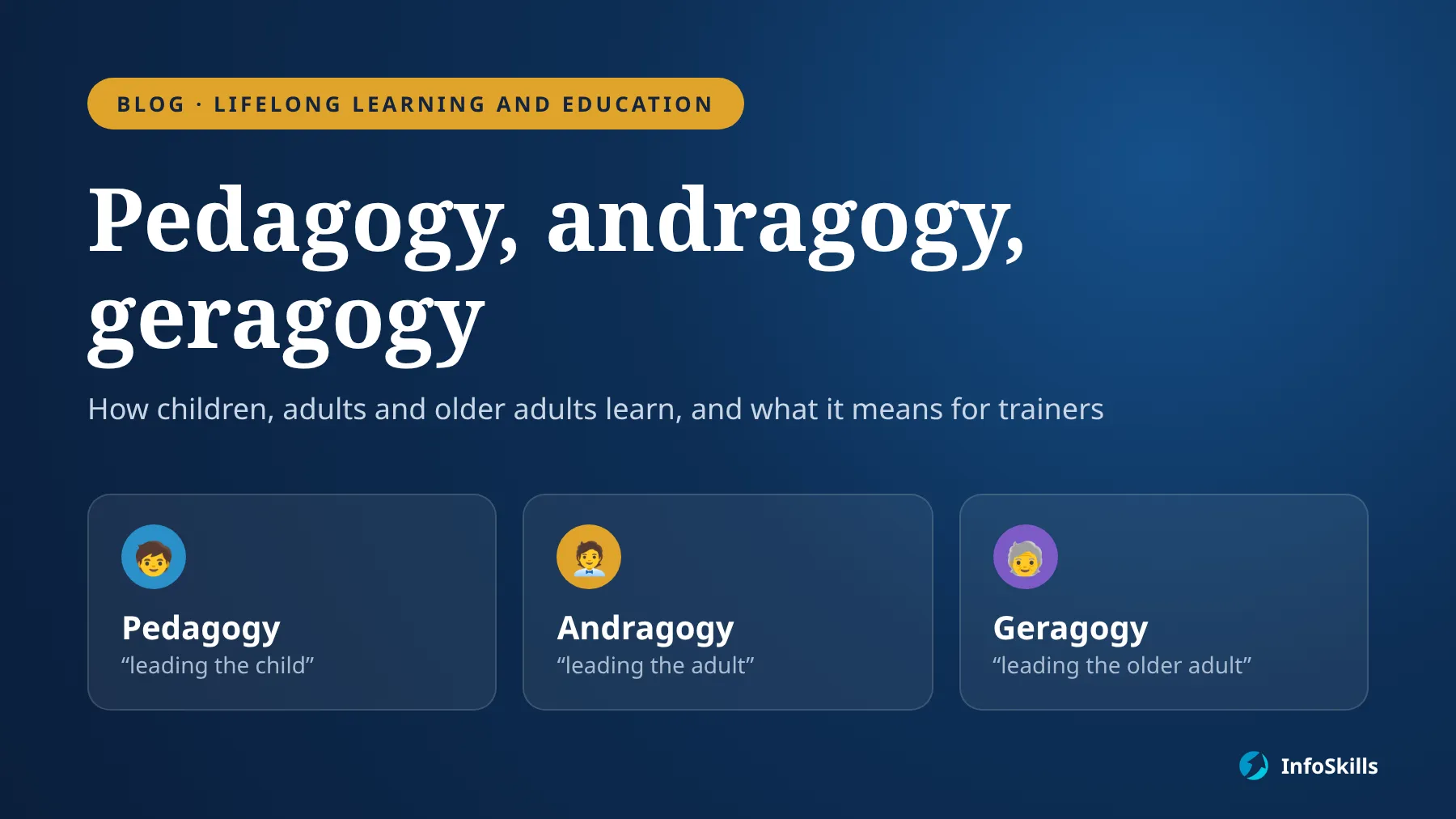
All three terms are built around the Greek word agōgós (“leading”, “guiding”):
- Pedagogy: paidós (child) + agōgós, “leading the child”
- Andragogy: anḗr, andrós (man, adult) + agōgós, “leading the adult”
- Geragogy: gérōn (old man, elder) + agōgós, “leading the older adult”
For centuries pedagogy was simply a synonym for “education”. The other two concepts were born when people noticed that an adult is not a grown-up child, and an older adult is not just an “older” adult.
Pedagogy: when the teacher leads
In the classic pedagogical model, the teacher decides what, when and how to learn. The learner largely depends on the teacher, their own experience still plays a small role in the material, learning is organised around subjects, and motivation is often external: grades, exams, the expectations of parents and society.
It is important not to get this wrong: “pedagogical” does not mean “bad” or “outdated”. Malcolm Knowles himself acknowledged in 1980 that there are situations where a pedagogical approach suits adults too, and that the models are “probably most useful when seen not as dichotomous but rather as two ends of a spectrum” [12].
Andragogy: the adult as the owner of their learning
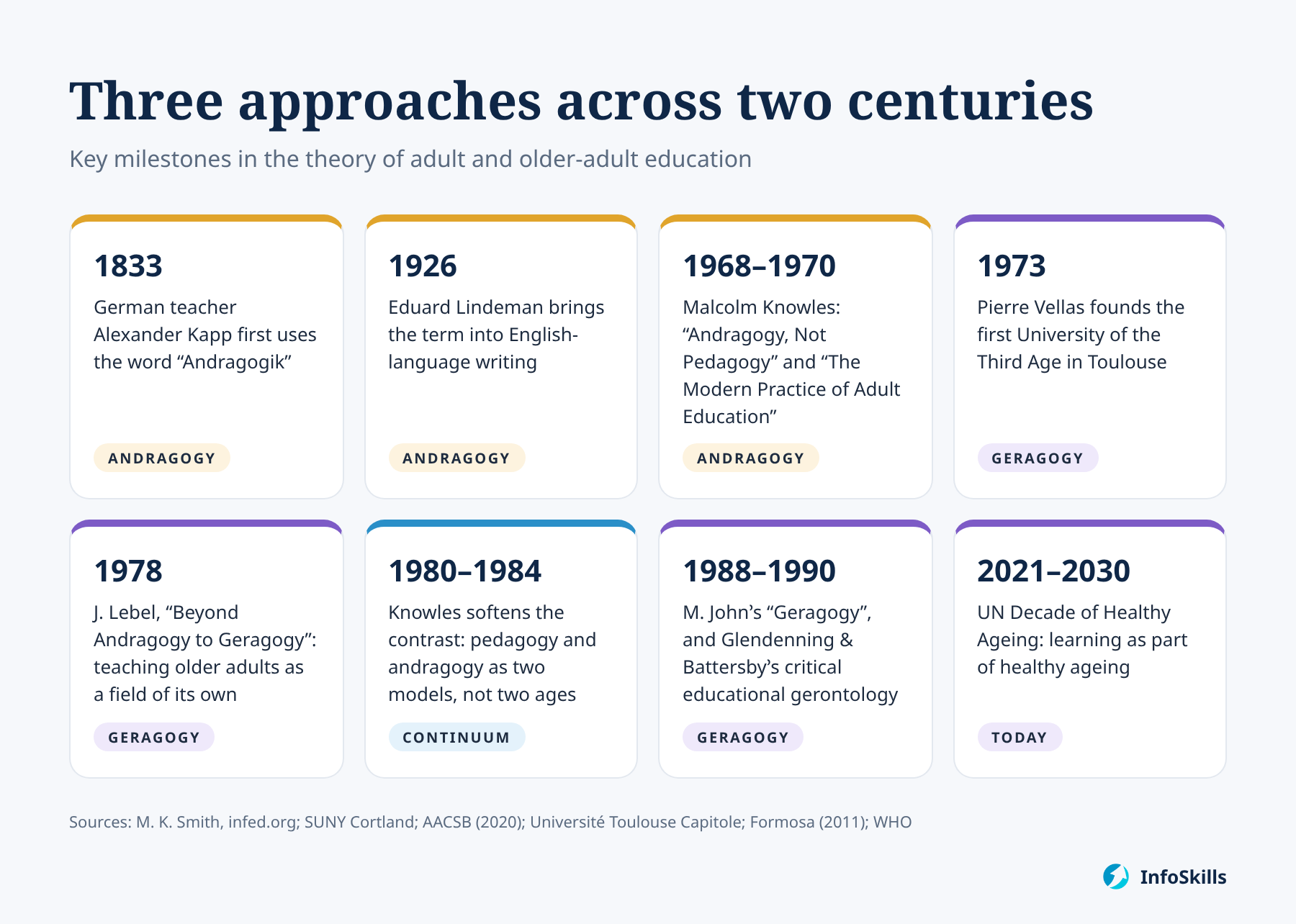
The word Andragogik was first used by the German teacher Alexander Kapp in 1833 to describe Plato’s educational ideas for adults. Eduard Lindeman brought the term into the English-speaking world in the 1920s, but it became truly famous thanks to the American educator Malcolm Knowles, who had learned about it from his Yugoslav colleague Dušan Savićević [2][3].
In 1968 Knowles published the article “Andragogy, Not Pedagogy”, and in 1970 the book The Modern Practice of Adult Education: Andragogy Versus Pedagogy. He defined andragogy as “the art and science of helping adults learn” [1][2]. His model rests on a number of assumptions about the adult learner, which over the years grew to six [3]:
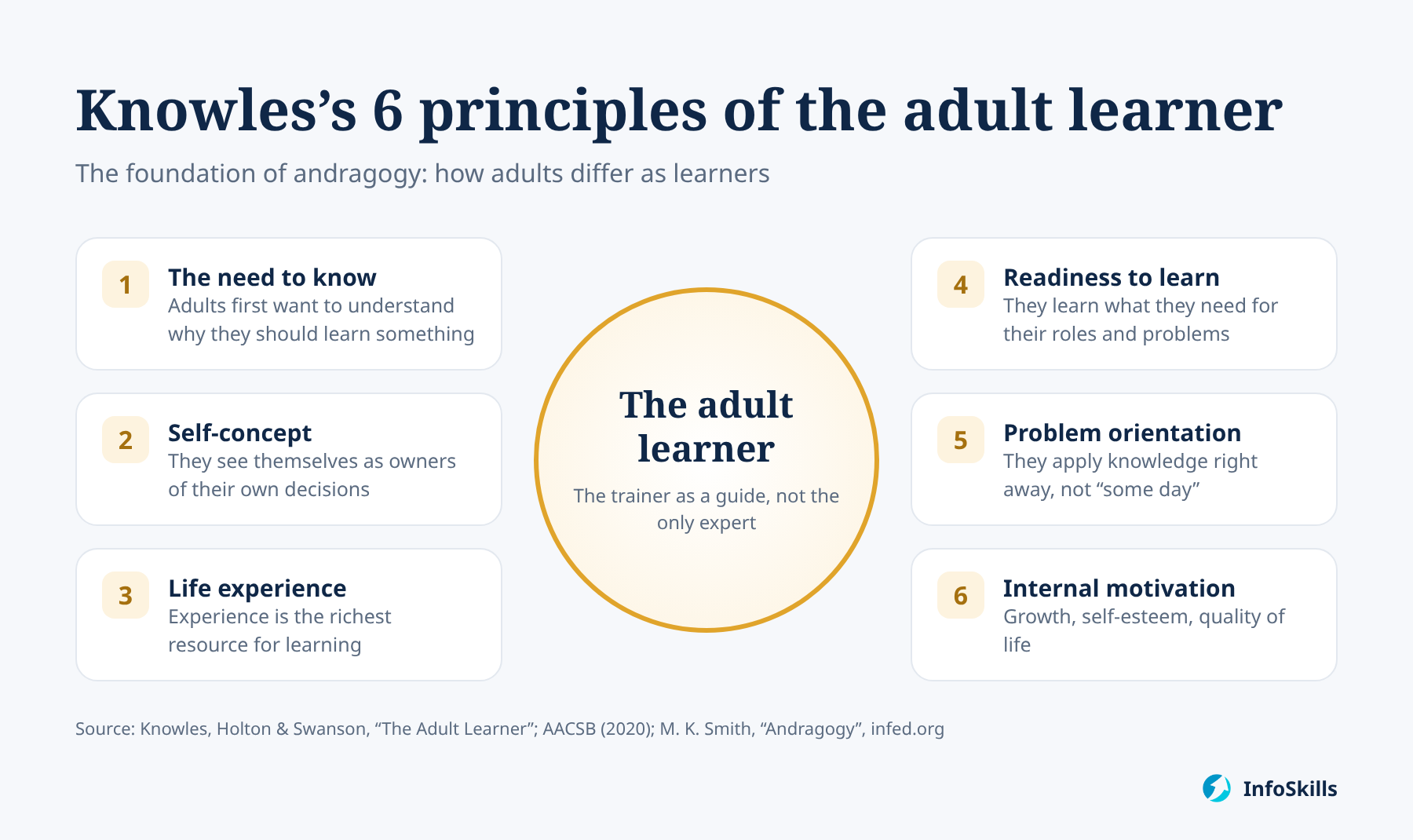
In practice this means:
- Start with “why”. Adults need to see how the material solves their real problem.
- Use the group’s experience. Every participant brings years of experience, which can become the most valuable material of the course.
- Prefer process over content. Case studies, role plays, simulations, self-assessment [2].
- Involve learners in planning. Adults learn more responsibly when they take part in setting goals and assessing results.
- The trainer as facilitator. Not the only expert in the room, but a guide who creates the conditions for learning.
Geragogy: learning in the third age
In the 1970s researchers noticed that andragogy does not answer every question either. Older learners have their own characteristics: different goals, a different sense of time, different health and sensory needs. In 1978 J. Lebel published the article “Beyond Andragogy to Geragogy”, and in 1988 M. John published the book Geragogy: A Theory for Teaching the Elderly [4].
At the same time, educational gerontology took shape, and in 1990 F. Glendenning and D. Battersby laid the foundations of its critical strand. They argued that education for older people should be not just a form of leisure but a means of empowerment, helping people gain more control over their own lives and knowledge. Marvin Formosa, a professor at the University of Malta, developed these ideas into “critical geragogy”, adding listening, love and tolerance as prerequisites of geragogy [5].
The idea quickly became practice too: in 1973 in Toulouse, law professor Pierre Vellas founded the first University of the Third Age (Université du Troisième Âge) [6]. Today such universities operate in dozens of countries, and in many of them older people teach each other.
What science says about the ageing brain
A common stereotype is that the ability to learn simply declines with age. The reality is more interesting:
- Crystallised intelligence (accumulated knowledge, vocabulary, judgement that comes from experience) usually grows or holds steady with age, while fluid intelligence (the ability to solve new problems quickly) and processing speed gradually decline [7].
- The brain actively compensates for these changes by recruiting additional neural networks. Denise Park and Patricia Reuter-Lorenz called this the brain’s “scaffolding” mechanism, which protects cognitive function and is strengthened by cognitive engagement and physical exercise [8].
- In the Synapse project at the University of Texas at Dallas, 221 participants aged 60 to 90 spent about three months, roughly 15 hours a week, on mentally demanding new activities: digital photography or complex quilting. Memory improved only in these groups, not among those who only socialised or did light activities [9].
The conclusion is simple: older people can and should learn new things; learning just needs to build on their strengths. Among M. John’s principles: a clear practical goal, a variety of methods instead of long lectures, focus on one topic at a time, warm encouragement, more time and repetition, and linking new material to life experience [4].
Why this matters so much today
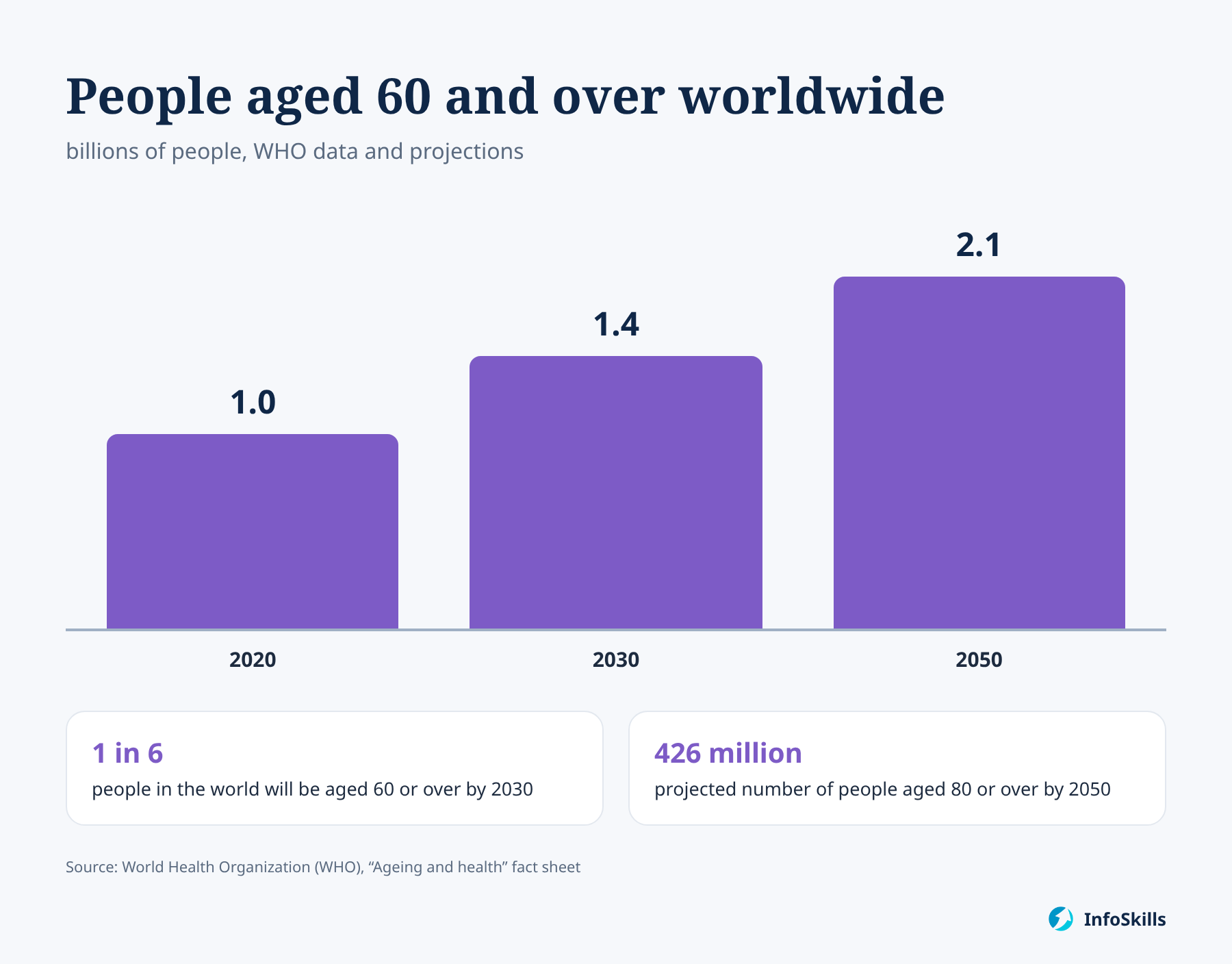
The world is ageing. According to the World Health Organization, by 2030 one in six people in the world will be aged 60 or over, and by 2050 the number of people in this age group will reach 2.1 billion [10]. The UN has declared 2021–2030 the Decade of Healthy Ageing, in which a person’s ability to learn, grow and make decisions is seen as part of healthy ageing [11].
For organisations, this means that four generations will increasingly work side by side in the same teams. Retaining the knowledge of long-serving professionals, teaching them new skills and enabling exchange with younger colleagues is becoming a central challenge of human resource management.
Three approaches side by side
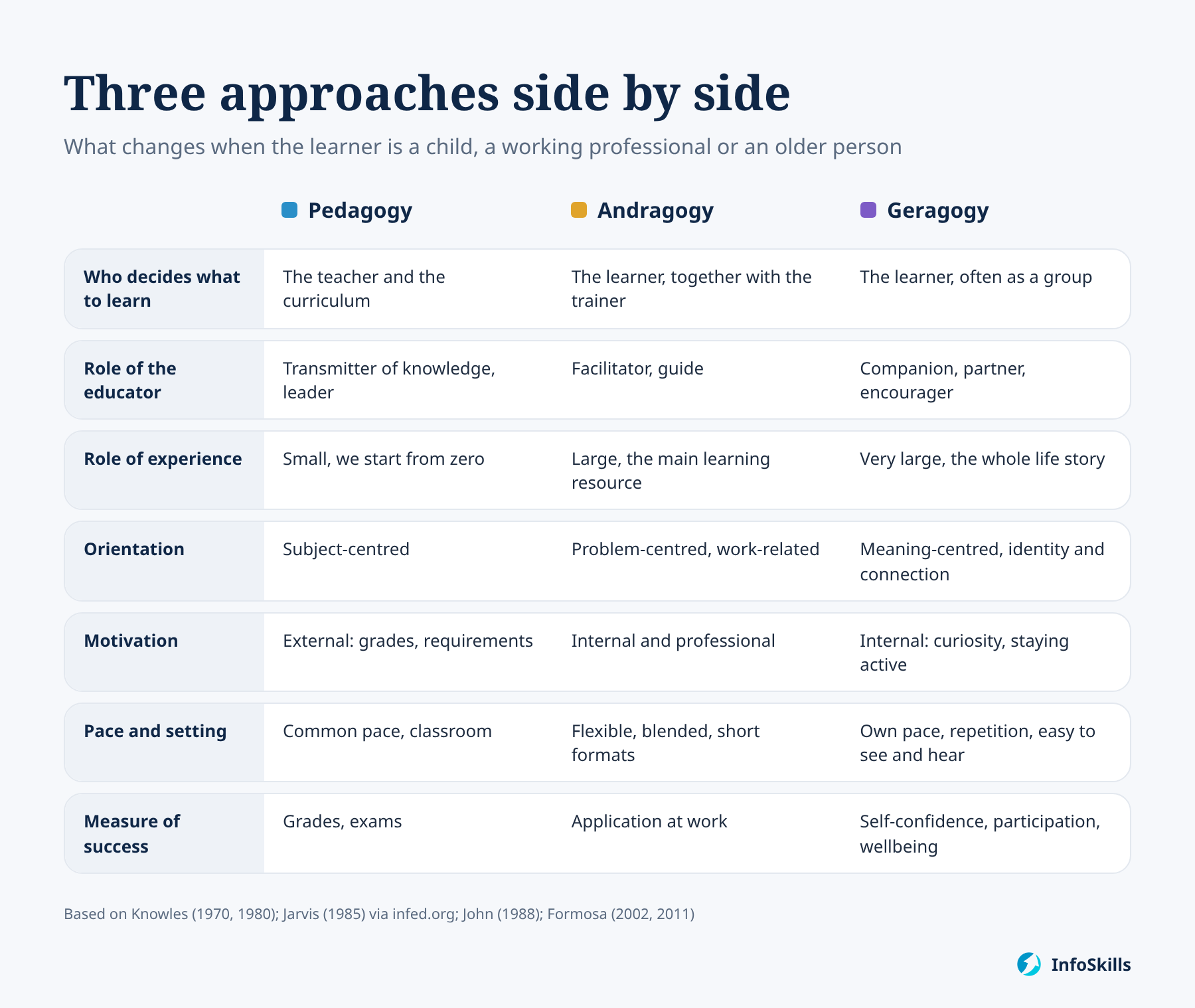
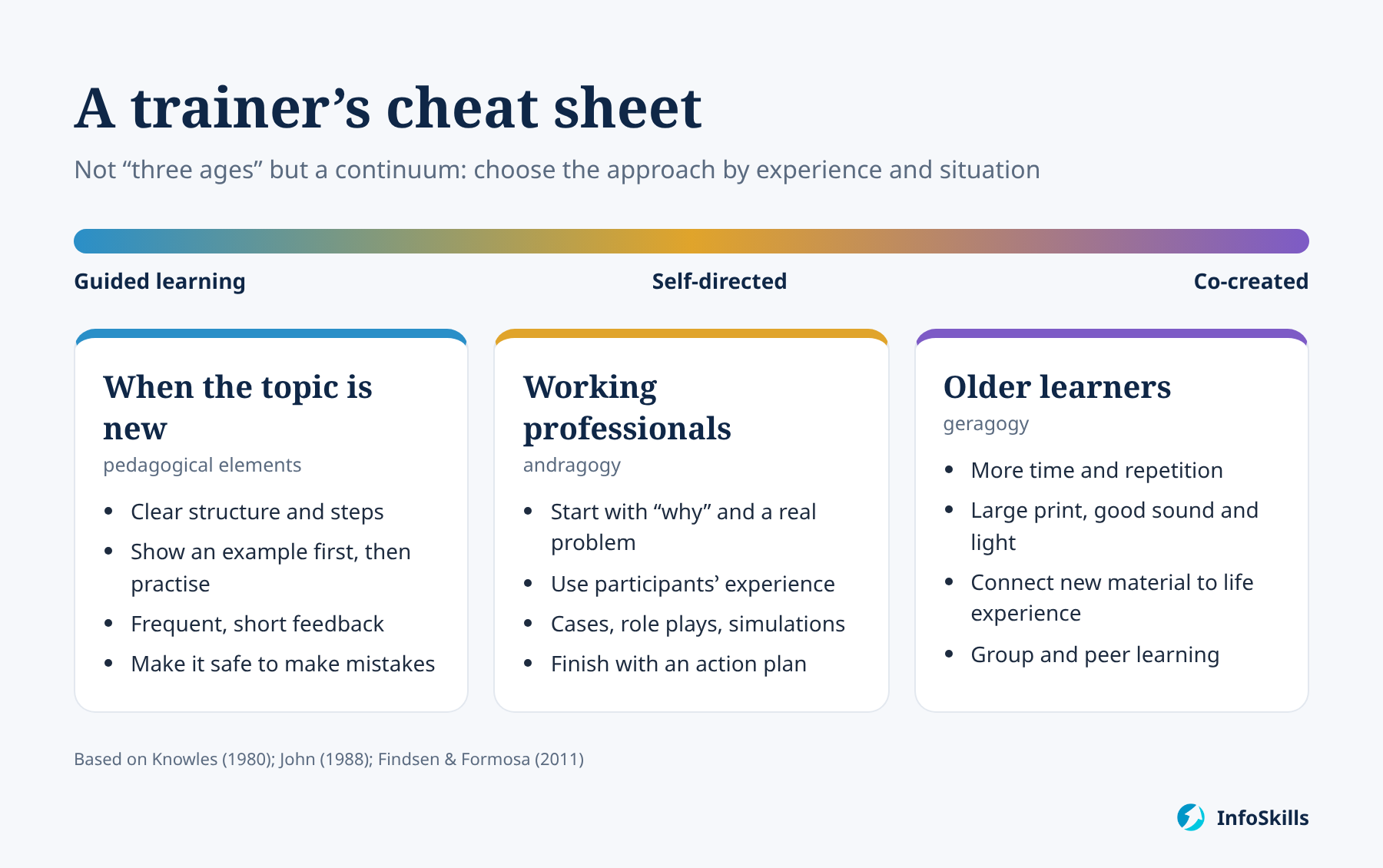
Not three boxes, but one continuum
These models also have critics, and their arguments are useful in practice. Peter Jarvis showed that for Knowles, pedagogy is “education from above” and andragogy is “education of equals”, so the difference is more a question of educational philosophy than of age. Stephen Brookfield pointed out that we see elements of self-direction in children too. Mark Tennant noted that the model lacks a coherent conceptual framework and that some of its assumptions say almost nothing about the learning process itself [1]. Knowles himself softened the contrast in the 1980s: by 1984 he presented pedagogy and andragogy as two models, content-based and process-based [1], closer to two ends of one spectrum [12].
The practical conclusion: choose the approach not by age on paper, but by the learner’s experience, goals and situation. An experienced manager learning data analysis for the first time needs pedagogical clarity at the start. A young team that has to solve a real business problem will learn best in an andragogical format. And a 65-year-old expert can be not only a learner but the most valuable teacher in the course.
How we apply this at InfoSkills
InfoSkills courses are designed for working adults, so they are built on the principles of andragogy:
- we build every programme around the client’s real problems, clarifying in advance what needs to change at work;
- most of the course is practical: cases, role plays, simulations, group work;
- we turn participants’ experience into a source of learning, and the trainer acts as a facilitator;
- in multi-generational groups we create conditions for experienced and younger colleagues to learn from each other;
- every course ends with a personal action plan.
Learning has no age. Age and experience only determine how to learn most effectively.
Sources
- Smith, M. K. (1996, 1999, 2010). Andragogy. What is it and does it help thinking about adult learning? The Encyclopedia of Pedagogy and Informal Education. infed.org
- Andragogy (Malcolm Knowles). Instructional Design Theories, SUNY Cortland. web.cortland.edu
- All for Andragogy (2020). AACSB Insights. Knowles, M. (1970). The Modern Practice of Adult Education: Andragogy Versus Pedagogy. aacsb.edu
- Geragogy. Wikipedia (with references to Lebel, 1978; John, 1988; Battersby, 1987; Findsen & Formosa, 2011). en.wikipedia.org
- Formosa, M. (2011). Critical educational gerontology: A third statement of first principles. International Journal of Education and Ageing, 2(1), 317–332. um.edu.mt
- The University of the Third Age celebrates its 50th anniversary. Université Toulouse Capitole. ut-capitole.fr
- Crystallized versus fluid intelligence. Lifespan Development, Lumen Learning (Horn et al., 1981; Salthouse, 2004). lumenlearning.com
- Park, D. C., & Reuter-Lorenz, P. (2009). The adaptive brain: Aging and neurocognitive scaffolding. Annual Review of Psychology, 60, 173–196. doi.org
- Mentally challenging activities improve memory as baby boomers age. The University of Texas at Dallas (2013). news.utdallas.edu; Park, D. C., et al. (2014). The impact of sustained engagement on cognitive function in older adults: The Synapse Project. Psychological Science, 25(1), 103–112. doi.org
- World Health Organization. Ageing and health. Fact sheet. who.int
- World Health Organization. UN Decade of Healthy Ageing (2021–2030). who.int
- Holmes, G., & Abington-Cooper, M. (2000). Pedagogy vs. andragogy: A false dichotomy? Journal of Technology Studies, 26(2) (quoting Knowles, 1980, p. 43). doi.org
© 2026 InfoSkills, Varuzhan Avanesyan. Reuse only with the author's permission and a link to the source.













No comments yet. Be the first.